Ancient mongolian states
Introduction: Hunnu Dynasty/209 BC-93 BC/
The first Mongolian state was the Hunnu Dynasty. All historical sources record that the Hunnu Dynasty called its khans Shanyu. The overthrow of his father Tumen Shanyu by his son Modun Shanyu and his accession to the throne of the Hunnu Dynasty is a part of history that attracts the attention of the world. There are various assumptions about when Modun Khan ascended the throne of the Hunnu Shanyu, but Mongolian scholars believe that it was in 209 BC. Modun Shanyu is a historical figure who introduced the organization of tumt, thousand, hundred, and ten to the Hunnu Dynasty. This means that before Genghis Khan introduced the organization of tumt, thousand, hundred, and ten, Modun Shanyu had introduced this organization into his state, army, and administration and made reforms. You can often read in books and textbooks that the leader of the Hunnu Dynasty was ordered to not give the land of my country even if he asked God for it. This can be explained by Modun Shanyu’s teaching that the foundation of the state is the land. It is said that the territory of the Huns stretched from Lake Baikal to the Great Wall and from the Korean Peninsula to the Western Frontier. Although they occupied vast territories in the bosom of Asia and Europe, it is very interesting that Ancient Korea is among the countries that Modun Shanyu could not conquer. The world has recently learned that the capital of the Huns was Luut City, which was found in Mongolia. The ruins are unique in that they are an important source for restoring and understanding history today. The ancient Han Dynasty existed next door to the Huns. Therefore, in 198 BC, the history records that the Huns signed a treaty with the Han Dynasty. According to the mutual agreement between the two countries, the Han Dynasty was in service to the Huns. Also, the main content of the first treaty between the Huns and the Han Dynasty was that the two countries mutually agreed to each other and set the border with the Great Wall. Needless to say, the ancient Han Dynasty was the Later Han and Tang Dynasties. The decline of the Huns is believed to have been caused by the struggle of the nobles of the dynasty for the throne, the numerous wars with the Han Dynasty, and the struggle of the nomadic tribes within the Huns. In the middle of the 1st century BCE, the Huns were divided into two parts: Zhiji and Huhanye. Specifically, in 53 BCE, the Huns were divided into the South and the North. In 215 BCE, the Southern Huns lost their independence, and in 93 BCE, the Northern Huns were recorded as having fallen. The Xianbei, who were under the rule of the Huns, are recorded as having joined forces with the Han Dynasty to destroy the first Mongol state, the Huns. Although the majority of the population of the Huns was ethnic Mongol, they were later conquered by the Northern Huns, and about 500,000 of their people became part of the Xianbei state. The term “Century” mentioned here refers to the pre-Century period, and “Century” refers to the Censure period.
Introduction Xianbei Dynasty /156-235 AD/
After the Huns, the Xianbi state existed in Mongolia. Although it was variously called Sunnu, Sumbe, and Donghu, its official name was Xianbi. The Xianbi state, which existed in Mongolia from 156 to 235, was founded by Tan Shihuai. Historians do not know him as the son of Prince Tolihui. History records that Tan Shihuai lived between 141 and 181. The people of Xianbi were genetically related to the Huns. In other words, Xianbi was a Mongol-speaking state that was related to the Huns by blood. The Xianbi lived from the Erchis River to the Xiangan Mountains, in what is now Mongolia, Kazakhstan, Russia, North Korea, and China, and is said to have ruled over the Manchu and Tungus peoples. Some sources state that the Xianbei people had a literate culture and that they translated Confucian teachings from the Nanxia language into the Xianbei language and taught it to their citizens. In other words, some literature states that literacy was created during the Xianbei period, but it does not mention what kind of script they used. The fact that Xianbei written records have not been found to date may be the main reason for this. So far, the oldest written record found in Mongolia is a illuminated statue with Brahmi script. It has been determined that the illuminated statue dates back to about 600 years, or 1,400 years, before the Genghis Khan Stone Inscription in the Hermitage in Russia. However, scholars estimate that the illuminated statue with Brahmi script is close to the Zhuzhan period, which established its own state in Mongolia after the Xianbei period. In that sense, what kind of script was used during the Xianbei period remains a mystery. Although the main rival of the Xianbei state was the Later Han, the main reason for the collapse of the state is believed to have been internal struggles for the throne. The Xianbei provinces later established their own states in Northern China.
Introduction: Zhuzhan Dynasty /333-555/
The Nirun state that existed in Mongolia from 333 to 555 is called Zhuzhang. Zhuzhang is said to have come from the word Zhou Zhang. The word Nirun is said to have come from the word Nuruu. The main part of the population of the Zhuzhang state was Mongol, and it is believed that they were direct descendants of the Huns and Xianbi. The southern neighbor of the Xianbi state at that time was the Toba Wei state. The Khan of the Toba or Tabgach province of the Xianbi dynasty captured a boy from his border guard post at the end of 220-277. Mugulyu /may be interpreted as Mongol/ later escaped from there and became one of his subjects. Mugulyu’s son Cheluhui /sometimes called Chargui/ called his subjects and the state as a whole Nirun. His 6th-generation grandson Jarun ascended the throne in 402, and the Nirun state is said to have become powerful. From his time, the title of Chen-Yu was replaced by the title of Khagan /Khan/. In other words, from the time of Jarun, the title of Khan began to be used. In general, during the approximately 200 years that the Zhuzhan state existed, a total of 23 khans of the Mugulyu dynasty were recorded in history between 330 and 555. The Zhuzhans conquered Turfan in 460 and settled in the Altai region, which was the main reason for its later decline. The people who were taken captive from Turfan began to revolt and fight in 552, and in 555 they overthrew the Nirun state and established the Turkic Khanate. It is said that the Mongols, who were hit by the Turkic invasion, left their lands and moved. This is why the Nirun belt island was found in Hungary. Some of them moved west and settled in the Crimean Peninsula and the North Caucasus in the 570s. With the fall of the Nirun state, the culture that the Mongols had previously acquired weakened to the Khitan.
Introduction: Turkic Empire /552-750/
It is said that Buman helped Nirun suppress his enemy. In return, he thought that he would marry the daughter of the Khan of Nirun, but it turned out that he did not. Therefore, Nirun’s enemy Toba married Princess Chang-Le of the Wendi Khan of Wei. Thus, Toba united with the Wei and suppressed the Nirun. Thus, in 552, the Turkic tribes occupied the Nirun, and the Turkic Khanate, led by Buman, led by the Altai Turks, was established. Buman was elevated to the title of Il Khan, which marked the beginning of the Turkic use of the title of Khan. The territory of the Turkic Khanate reached from the Great Wall to the Black Sea. Later, it was divided into the Western Turkic Khanate and the Eastern Turkic Khanate. The Western Turkic Khanate was ruled by Buman Khan’s brother Istegi, while the Eastern Turkic Khanate existed in Mongolia until it was defeated by the Uyghurs in 745. The Tang Dynasty was one of the countries that was instigated and supported by the nomads under the Turkic rule. When reading and studying the history of Mongolia, historical chronology discrepancies often arise. Therefore, it is worth noting that some data were selected and used from the Book of Soril, which was created after many years of research by Mongolian scholars and is said to be more accurate and precise in terms of chronology. The illuminated statues of the successors of the Turkic Khanate, Mohilian or Bilge Khan, and his younger brother, the military general Kultegin, were later found in Mongolia. This confirms that the Turkic Khanate lived in Mongolia. The inscription on the illuminated statue has been deciphered as Runic. In some cases, it is also called the Orkhon Valley script. The illuminated statue with the runic inscription is so called because it was found in the Orkhon Valley. But from abroad, monuments with runic writing were found in the Yenisei River valley, and further in Scandinavian countries such as Sweden, Norway, Finland, and Denmark. In other words, monuments with runic writing are found in Scandinavian countries such as Sweden, Finland, Norway, and Denmark, beyond the Orkhon Valley, along the Yenisei River. From these monuments with runic writing, it can be seen that the Turkic Khanate existed until the present day. The study of ancient Turkic monuments with runic writing was first started in 1889. Then, in 1890, an investigative team led by Nikolai Mikhailovich Yadrentsev announced at an international conference in Moscow that they had found ancient monuments with writing in the Orkhon Valley. In 1891, an investigative team led by V.V. Radlov not only studied the runic writing on Turkic monuments in the Orkhon River valley, but also discovered and registered some newly discovered written monuments on rock. Georg von Gabelnets studied the inscriptions on the Kul-Tegin light monument, Gabriel Deverna studied the inscriptions on the Bilge Khan and the Black Ruins light monuments, and Otto Danner compared the Yenisei and Orkhon scripts. He then compiled a list of the letters of the Kul-Tegin and Bilge Khan light monuments, and compiled and published a dictionary of 34 letters of the Yenisei script. On 11/25/1893, Professor and linguist Thomsen Wilhelm Ludwig of the University of Copenhagen deciphered the runic inscriptions found in the Orkhon and Yenisei valleys,It is said that the white alphabet was developed. However, participants in the Danish Imperial Scientific Conference determined that the Orkhon and Yenisei runic scripts are phonetic scripts with 38 letters. Incidentally, the Yenisei River flows through Russia and empties into the Arctic Ocean, and is the 5th longest river in the world. Some sources state that the Yenisei River originates in the Khuvsgul province of Mongolia, flows northward through central Siberia, and flows into the Kara Sea of the Arctic Ocean through the Yenisei Bay. The name Yenisei comes from the Evenk word Ioanessi.
Introduction: Uyghur Khanate /744-840/
The Uyghurs destroyed the Turkic Khanate and emerged on the stage of world history. In doing so, the Uyghurs established their own state twice. Of course, after a long struggle with the Turks who existed before them, the Uyghurs left a mark in history that they established their own state. The Uyghurs are often referred to in history as the High Chariots. In 625-628, the High Chariots fought the Eastern Turks and sent Turkic representatives from Mongolia to establish their own state. In this regard, some sources indicate that the Uyghurs established their first state in history by destroying the Turkic state in 647. However, the state established by the Uyghurs was destroyed by the Turks in 690. 50 years later, the Uyghurs rebelled against the Turks again. This allowed the Uyghurs to establish their own state for the second time. The First Uyghur Dynasty lasted from 647 to 693, and is considered the period when the Uyghurs first established their state. The Later Uyghur Dynasty lasted from 744 to 840, and is considered the period when the Uyghurs established their state for the second time. The Uyghurs fought the Turks and established their own state twice, as mentioned above. However, historians often consider the Later Uyghur Dynasty to be the date of the founding of the dynasty. During this period, in 744, Kullig was elevated to the title of Khan Boyla, and the Uyghurs rose to power again in history, but it is said that the last Khan was killed by the Kyrgyz in 839. In general, historians believe that the struggle of the Kyrgyz, which began in 820, was the main factor that contributed to the demise of the Uyghurs. It is said that the remaining Uyghurs left their homeland and moved in three directions, towards the Tang Dynasty, Ganzhou, and Kucha-Karasha. Before that, during the occupation by the Huns, Zhuzhan, and Turks, there is evidence that the Uyghurs migrated to Hungary. In this regard, there is evidence that approximately 200,000 of them fled and settled in Hungary. From here, it can be noticed that the names ancient Uyghur and modern Hungarian are written nearby. Historians will list some historical facts and figures that can be found in modern-day Ukraine as traces of the ancient Uyghurs. In other words, there are historians who believe that the ancient Uyghurs are modern-day Ukrainians. It cannot be denied that the Uyghurs who left their land during the Huns, Zhuzhan, and Turks settled at least in Ukraine and then in Hungary. Therefore, in order to study the history of the Uyghurs, it is necessary to study at least Ukraine and then Hungary. The question arises as to which country the Uyghurs had extensive religious and cultural relations with. The majority of people answer this question as India. However, according to scientists, the correct answer is Sogd. Sogd was a small province rather than a country, and it was settled in the territory of present-day Iran. There is little concrete data on this, and when searching the Internet, Sogd was the name of a country in Central Asia. There is no other word or sentence that can be found other than that the Sogdians are essentially a historical Iranian nation. From this, it is clear that there is an urgent need to further study such things that have been forgotten and left unstudied in history.Another fact related to the Uyghurs and Sogd is that the Uyghur Mongolian script originated from the Sogdian script. It is worth noting that there is at least one historical account of Genghis Khan’s secretary Tata-Tunga creating the Uyghur Mongolian script from the Sogdian script and alphabet, which originated from the Aramaic language. So I searched for data on the Sogdian language, script, and alphabet. Not much. The Sogdian language had three types of scripts. Specifically, it consists of three parts: Sogdian script, Manichaean, and Syriac, and is considered to be part of the Aramaic language group. The script and alphabet covered China from Iran in the west to the east between approximately 100 and 1200. The Sogdian script has 17 consonants, most of which have many types, including initial, medial, and final consonants. The language, script, and alphabet are now considered extinct languages. However, it turns out that Tata-Tunga managed to create the Uyghur Mongolian script before its extinction. From here it can be seen that the oldest Mongolian scripts include Brahmi from the Zhuzhan period, Runi from the Turkic period, and Sogdian from the Uyghur period. By the way, the Uyghur capital is called the ruins of Khar-Balgas, which were found in Mongolia. Perhaps, during the excavations here, relics with the ancient Sogdian language, script, and alphabet will be found.
Introduction: Khitan Dynasty /907-1125/
A few years ago, the Khitan dynasty was taught in history classes, but today the name has changed to Khitan. At first glance, Khitan seems close to the word China. However, its origin and history are completely unrelated to China. The Khitan are closely related to the Donghu in origin. In other words, the Donghu, or the last king of the Xianbei state, Kebigen, is considered the supreme ancestor of the Khitan people. However, the majority of the population of the Khitan dynasty was of Mongolian ethnicity. Therefore, of course, the people of the dynasty spoke Mongolian. However, there are some characteristics that distinguish them from previous dynasties in terms of literacy. The Khitans had two types of literacy: upper and lower. The first king of the dynasty, Ambagyan, established the upper script in 920, while his younger brother established the lower script in 925. The upper script had 1,000 characters, while the lower script had 378 characters. These are still unsolved. In the early years of the dynasty, the king was elected every three years, but from 917 onwards, it was hereditary. The Khitan dynasty, which existed in present-day Mongolia from 907 to 1125, was destroyed by the Golden Horde of the Zurqids and the Song Dynasty of China. The six ancient states that existed in Mongolia can be named as follows. In these ancient states, land and pastures were owned by the state, while livestock were privately owned. All scholars agree that the basis of the economy of ancient Mongolian states was livestock farming.
Introduction: All of Mongolia
After the Khitan dynasty was destroyed by the Golden Horde of the Zurchids and the Sun Dynasty of China, the Mongols lived in many small tribes and provinces. Despite being scattered and scattered for about 100 years, the historical figure who reunited the original Mongol provinces and established his own state was Temujin or Genghis. The name Temujin was given by his parents can be understood as the title of Khan that Genghis bestowed on him by the Mongols. His father Yesukhei, while leading the Mongol provinces, defeated the Tatars in 1162. It is said that among the Tatar leaders were Temujin-Uge. Therefore, it is a very strange part of history that he named his son Temujin to commemorate his victory over his enemies. Temujin was born in 1162 in Deluun Boldog, Onon, which is now Dadal sum, Khentii province. When he was nine years old, in 1170, Yesukhei the hero Uulen accompanied Temujin on a journey to find a wife for him from his mother’s land. On the way, he met Dai Setsen, the headman of the Khongirad aimag, and his daughter Burteg asked him to become Temujin’s future wife. On the way back, leaving Temujin there, Yesukhei the hero was killed by the Tatars while attending a feast. It is worth noting that one thing needs to be distinguished here. Ambagai Khan of the Khamag-Mongols took his daughter to marry the Tatars and was killed. The Tatars went because they had offered to make peace. However, they reneged on their promise, captured Ambagai Khan, and then sent him to the Golden Land. It is also mentioned in history that Ambagai Khan was tortured to death by being tied to a wooden donkey by the Golden Lands. It is also worth noting that the Ambagai Khan of the Khamag-Mongols mentioned here is different from the Ambagyan Khan of the Kidan Dynasty. Ambagai Khan was going to marry his daughter-in-law, and Yesukhei Baatar was going to ask for a bride for his son, and on the way he was attacked by Tatars. This clearly shows that the Tatars were the eternal enemies of their ancestors. Temujin’s enemies did not stop with the Tatars, even the Mergids were hostile. The word Mergid means wise people. They were called the Three Mergids because they were a union of three small provinces. Historians believe that they lived in the Selenge and Orkhon river valleys. Once, Temujin escaped from the Mergid attack and hid in the thickets of Mount Burkhan-Khaldun and survived. Since then, Temujin began to worship Mount Burkhan-Khaldun, which had saved him in its dense thickets. Burkhan-Khaldun is still among the sacred mountains of the state today, and the tradition of worshipping it continues. Even after that, Temujin’s struggle with the Mergids did not stop. The long-term struggle may have originated with Yesukhei Baatar and Öulen Ujin. Specifically, when the Magi were on their way to marry Öulen of the Ikh Chiledu Olkhon tribe of the Magi province, Yesukhei Baatar of the Khamag-Mongol kidnapped her from the road and took her as his wife. In response, around 1181, the Magi attacked Temujin and captured his wife Burte. Since the stories of Öulen and Burte are similar, there are people who confuse them. Therefore, it is said that it is worth distinguishing them.Therefore, Temujin went on a campaign against the Magi and freed his wife Burte. It is said that the Magi’s power was weakened by this attack. In 1189, Temujin, together with his friend Jamukh and his father’s friend, Van Khan Tooril, seized the country ruled by his father and was crowned Khan of the Khamag-Mongols at Lake Khokhnuur in the Black Heart. Thus, Temujin was officially crowned Khan of the Khamag-Mongols after his ancestors Khabul, Ambagai, and Khutula. However, in 1206, he was crowned Khan of the Great Mongols at the Great Khural held at the head of the Onon River. In other words, historians believe that Temujin is one of the leaders who founded the Khamag-Mongols, the Great Mongols, and the Mongol Empire.
Introduction: The Great Mongol Empire /1206-1260/
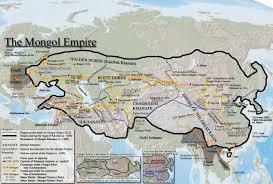
Temujin was proclaimed the khan of the Great Mongol Empire in 1206 at the Great Khuraldai held at the head of the Onon River. The khanate at the head of the Onon River was significant. This place was chosen because it was suitable for gathering a large number of people and holding the Great Khuraldai. Thus, the Great Khuraldai gathered the noble Mongols and united them to form the Great Mongol Empire. The highest decision-making body of the Great Mongol Empire was the Great Khuraldai. The nominated person was discussed at the Great Khuraldai and was proclaimed the khan. The Great Khuraldai also discussed and decided on foreign and internal issues of the state, such as friendship and war with foreign countries. The Golden Clan, state officials, scribes, and generals would participate in the Great Khuraldai. The Great Mongolian Empire had a Great Government, and the administrative units were divided into ten, hundred, thousand, and tum. After the Mongol provinces of Ergune merged, became the core of the Mongols, and established the Great Mongol Empire, Genghis Khan set out on foreign campaigns. He would start a campaign, but never finish it. As soon as it became clear that he would win, he would decide who to subjugate and set out on the next campaign. In this way, his territory extended from the Great Wall to Lake Baikal, and from the Khyangan Mountains to the Altai Mountains. Furthermore, he conquered countries such as the Golden Horde, the Khorezm Khanate, Central Asia, the North Caucasus, Russia, Poland, and Hungary. In the history of the Mongol Empire, it is often said that Genghis Khan bequeathed the lands he conquered to his four sons. In the Secret History of the Mongol Queens by author Jack Waterford, Genghis Khan united the scattered tribes and provinces, first subjugating their lands to his queens, and then set out on foreign campaigns. He later subordinated the countries he conquered through foreign campaigns to his daughters. Finally, the idea of subordinating the conquered lands to his sons is emphasized. In other words, the lands that remained under the rule of the queens were surrounded by the lands of the daughters. However, the idea that the lands of the queens and princesses were surrounded by the lands of the sons and protected by the lands is emphasized here. Genghis Khan had queens named Borte, Khulan, Yesui, and Yesugen, from whom he had 4 daughters named Alaltun, Checheikhen, and Alaga, and 4 sons named Zuchi, Chagadai, Ogeudei, and Tolui. Genghis ruled and ruled the lands he conquered. However, he did not simply rule the conquered countries through his daughters. History tells us that he intermarried with his daughters, princes of cities along the Silk Road, where trade was concentrated. For example, the Uyghurs along the Silk Road were ruled by Alaltun Behi, the Ongud by Alaga, and the Kazakhs by their remaining daughter. Although Chechey ruled the Oirats, he was weaker and less successful than the others. Alaltun and Alaga are said to have carefully prepared the bases for Genghis’ further campaigns in their cities along the Silk Road. In this way, they further expanded their territory and laid the foundation for the establishment of the Mongol Empire.Genghis Khan died of wounds sustained while on a campaign in 1227. The area where Genghis Khan was buried is known as the Great Khorig, which is now part of Inner Mongolia. After his death, his sons invaded the lands of the khans and princesses, and eventually fought each other. Although they fought each other, they were able to expand the Mongol Empire to some extent. The Great Mongol Empire expanded and became the Mongol Empire. The Mongol Empire was divided into four khanates: the Golden Horde, the Ilkhanate, the Chagatai, and the Yuan Dynasty, and these four khanates were ruled by Genghis’ four sons. Historians believe that they continued to fight and sometimes unite until the 16th century.