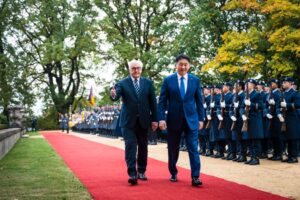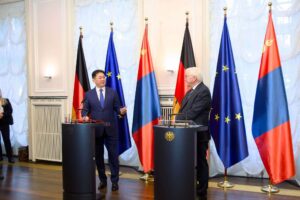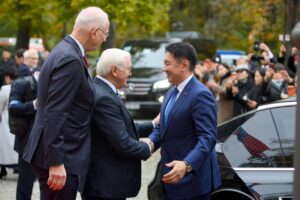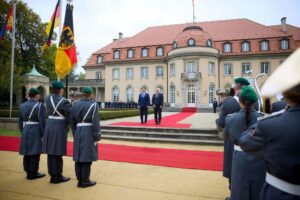
Frank-Walter Steinmeier: “This time around, the Mongolians have actually made it all the way to Berlin – in a very peaceful manner”
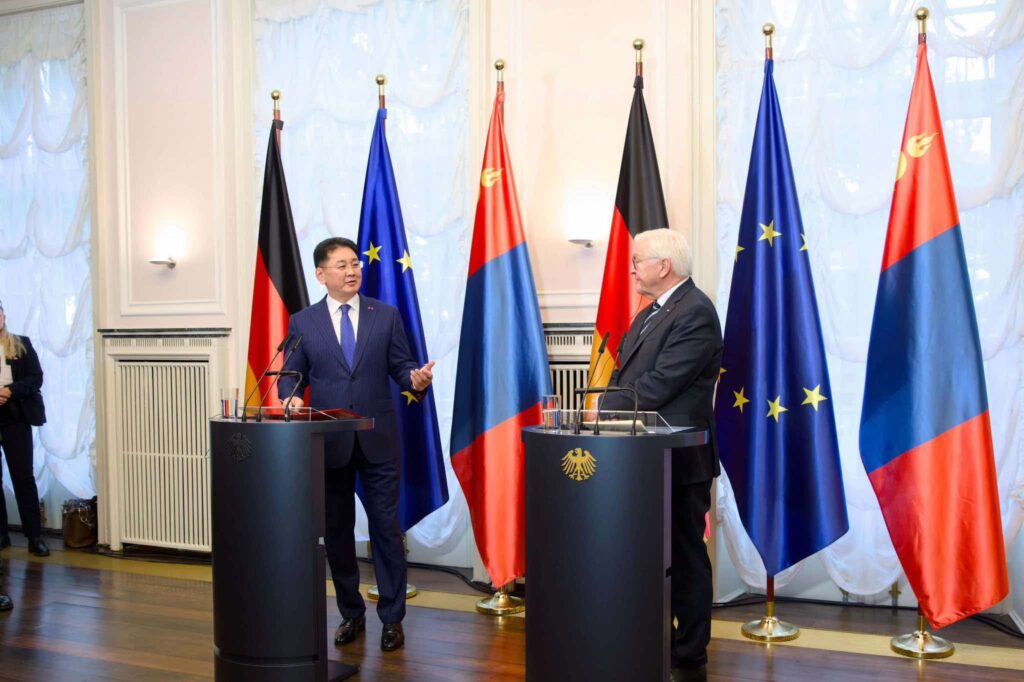
20 October 2026. Germany. Berlin. “Genghis Khan is one of the most significant and formidable rulers in world history.” Federal President Frank-Walter Steinmeier said at the opening of the exhibition “Genghis Khan and the World of the Mongols”. “In 1995, the Washington Post proclaimed him ‘man of the millennium’. Indeed, were it not for him, a large part of the history of Asia – and also of Eastern Europe – would have unfolded differently.”
Translation of advance text.
Things could have turned out quite differently. This is something of a truism when you consider the extent to which contingency and coincidence played a part in history unfolding in the way it actually did. At many different inflection points, you might be forgiven for asking: what would have happened if events had taken just slightly a different turn here? What potentially far-reaching developments might have resulted from this?
What, for instance, would have become of the Holy Roman Empire had the Mongols continued their advance in the 13th century, heading west and south, had the Battle of Liegnitz in 1241 not remained the westernmost point of their conquests? Liegnitz, in what is now Poland, is just 240 km from here, from Berlin – not far away when you consider the roughly 6000 km that lie between our country and present-day Mongolia.
Such historical speculations along the lines of “what if…” can sometimes actually give rise to insights. In this case, however, one thing is perhaps brought home to us very clearly, namely that when we talk today about globalisation turning the world into a village, about everything getting ever closer together, that much of what appears to be happening far away will affect us, too, sooner or later. Things were sometimes not much different in the period that Europe calls the Middle Ages.
Seemingly on the very other side of the world, many thousands of kilometres away, a man had risen to power, a man who united a vast empire, endowing it with administrative structures, a strong army and a virtually invincible will to conquer and rule. Not long afterwards, his descendants stood at the gates of a Europe paralysed with fear.
Genghis Khan is one of the most significant and formidable rulers in world history. “Formidable” is apposite here in many respects. His conquests swept away entire civilisations, entire regions and, above all, countless human lives. This formidable Genghis Khan continues to stir the imaginations and fantasies of many people around the world to this day. In 1995, the Washington Post proclaimed him man of the millennium
. Indeed, were it not for him, a large part of the history of Asia – and also of Eastern Europe – would have unfolded differently; and certainly, without him and his immense unifying legacy, we could not speak of the “World of the Mongols” in the way that this exhibition, which we are opening today, does. Given everything that I have learned, it is inconceivable that the “World of the Mongols” and “Genghis Khan” should not be so closely linked in the title.
The fact that this exhibition is taking place here in Berlin, of all places, in Germany, is anything but a coincidence. An intensive and fruitful archaeological collaboration has been in place between our two countries for a long time now – since 1999, to be precise. Twelve years ago, Professor Fless, we were able to embark on a further stage of this cooperation together in Mongolia, namely joint excavation and conservation work in the ancient capital of Karakorum. Two years ago, during my state visit to Mongolia on the occasion of the 50th anniversary of diplomatic relations between our countries, we signed the agreement for this new, major exhibition.
My particular thanks go to you, Professor Wemhoff, and to you, Professor Chuluun, for pursuing this great project with such determination. And I am especially delighted that we are able to view the results of what was decided back then today, still prior to the end of my term of office.
Anyone visiting this exhibition today sets out on a journey through time and space. We encounter a fascinating yet unfamiliar world, a world that fills us with wonder. It is an exhibition that introduces us, in a manner of speaking, to people from the other side of the world and from times long past, and which never ceases to surprise us with their social and political forms of community-building and their cultural creations.
We are by no means the first Europeans to stand in awe before the treasures and artefacts of Mongolian culture. It is interesting and certainly very enlightening that, in the section of the exhibition devoted to the nascent capital, Karakorum – Genghis Khan’s very important foundation – we encounter a European traveller who was able to visit this city as early as around 1253. The Franciscan monk William of Rubruk allows us, through his vivid descriptions, to partake in the life he observed, in his wonder at quite a few things, and in his amazement – expressed without a trace of European arrogance – at all that was unfamiliar, at the beauty and grandeur that met his eyes. To be able to see and give expression to all this, this foreign world must somehow have been accessible and indeed made sense to his European mindset.
Yes, perhaps the most surprising thing is not the strangeness of a culture so distant from us both temporally and spatially – but the fact that we can understand it, that we encounter something so primal and so universally human. No, we certainly do not encounter what we have always been familiar with, recognised or understood. There is so much that is new and surprising. But we see something that we are able to understand deep down.
There is no culture that cannot tell us something about the human condition in this world – something that others can also grasp and that moves them deeply as well. Love and pain, pride and grief, hope and despair: emotions that we all know and that are expressed – and can be understood – in so many different ways. We will experience this once again here, at this exhibition.
I would like to thank everyone who has made this wonderful exhibition possible – and I wish it every success and the acclaim and popularity it so richly deserves. This time around, the Mongolians have actually made it all the way to Berlin – in a very peaceful manner.
Source: https://www.bundespraesident.de